

Classical Period
Classical antiquity, also referred to as the classical era, classical period, classical age, or simply classical history or antiquity, is the time period of cultural history that is relevant to the Mediterranean region and dominated by the Greco-Roman world between the 7th century BC and the late 5th century AD. It is the time when ancient Greece and ancient Rome were at their height and had a significant impact on much of Europe, North Africa, and West Asia.


Famous Artworks

Parnassus
(1642)
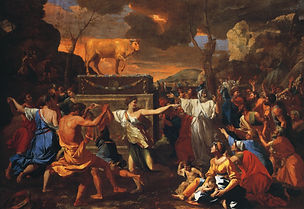
The Adoration of the Golden Calf
(1634)
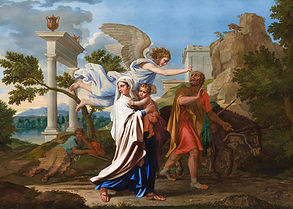
The Flight into Egypt
(1658)
Nicolas Poussin
Although he spent the majority of his working life in Rome, Nicolas Poussin was the foremost painter of the classical French Baroque style. For a select group of Italian and French collectors, he painted the majority of his religious and mythological works. He briefly went back to Paris to take on the position of First Painter to the King for Louis XIII and Cardinal Richelieu, but he soon returned to Rome and continued working on his more conventional subjects. Later in life, he began to emphasize the landscape more and more in his paintings. Clarity, logic, and order are traits of his work, and he prefers line to color. He continued to serve as a major source of inspiration for classically inclined artists like Jacques-Louis David until the 20th century. The specifics of Poussin's artistic education are somewhat hazy. He went to Paris sometime around 1612, where he studied under amateur masters and finished the earliest of his surviving works.
He traveled to Rome in 1624 to study the works of Renaissance and Baroque painters, particularly Raphael, who had a significant impact on his style. He was inspired by the Italian artworks he saw in the royal collections in Paris. He made friends with several artists who favored the classical style and got to know influential patrons like Cardinal Francesco Barberini and antiquarian Cassiano dal Pozzo. As a result of the modestly scaled religious, mythological, and historical commissions Poussin received, he was able to create works like The Death of Germanicus, The Massacre of the Innocents, and the first of his two series of the Seven Sacraments.
John Flaxman
British sculptor and draughtsman John Flaxman RA, who lived from 6 July 1755 to 7 December 1826, was a key figure in both British and European Neoclassicism. He started out his career by modeling pottery for Josiah Wedgwood. He resided in Rome for a number of years, where he created his first book illustrations. He produced numerous monuments for burials.
By 1780, Flaxman had also started to carve grave markers for money. He left early memorials for Thomas Chatterton in the Bristol church of St. Mary Redcliffe (1780), Mrs. Morley in the Gloucester Cathedral (1784), and the Rev. Thomas and Mrs. Margaret Ball in the Chichester Cathedral (1785). Memorial bas-reliefs of this kind made up the majority of Flaxman's output for the remainder of his career and can be seen in many churches across England. One such example is the monument to George Steevens, which was formerly located in St Matthias Old Church but is now housed in the Fitzwilliam Museum in Cambridge. His best monumental work was praised for its pathos and simplicity, as well as for fusing a truly Greek instinct for rhythmical design and composition with a spirit of domestic tenderness and innocence.


Famous Artworks

The Adoration of the Magi
(1755-1826)

Illustration to the Iliad
(1793)

Angels rescuing a soul from the ranks of the dead
(1755-1826)

Famous Works

Adante
(1792)

Surprise
(1791)
Franz Joseph Haydn
Although he spent the majority of his working life in Rome, Niklas Pus (French: [nikla pus]; June 1594 – 19 November 1665) was the foremost painter of the classical French Baroque style. For a select group of Italian and French collectors, he painted the majority of his religious and mythological works. He briefly went back to Paris to take on the position of First Painter to the King for Louis XIII and Cardinal Richelieu, but he soon returned to Rome and continued working on his more conventional subjects. Later in life, he began to emphasize the landscape more and more in his paintings. Clarity, logic, and order are traits of his work, and he prefers line to color. He continued to serve as a major source of inspiration for classically inclined artists like Jacques-Louis David until the 20th century. The specifics of Poussin's artistic education are somewhat hazy. He went to Paris sometime around 1612, where he studied under amateur masters and finished the earliest of his surviving works.
He traveled to Rome in 1624 to study the works of Renaissance and Baroque painters, particularly Raphael, who had a significant impact on his style. He was inspired by the Italian artworks he saw in the royal collections in Paris. He made friends with several artists who favored the classical style and got to know influential patrons like Cardinal Francesco Barberini and antiquarian Cassiano dal Pozzo. As a result of the modestly scaled religious, mythological, and historical commissions Poussin received, he was able to create works like The Death of Germanicus, The Massacre of the Innocents, and the first of his two series of the Seven Sacraments.
Wolfgang Amadeus Mozart
Classical period composer Wolfgang Amadeus Mozart (27 January 1756 – 5 December 1791) was active and well-known. Despite having a brief lifespan, he produced more than 800 works in almost every genre at the time. Many of these works are regarded as the best in the choral, symphonic, concertante, chamber, and operatic canons. The music of Mozart is praised for its "melodic beauty, formal elegance, and richness of harmony and texture", making him one of the most revered composers in the history of Western music. Mozart, who was born in Salzburg, Austria, then part of the Holy Roman Empire, displayed extraordinary talent even as a young child. He began composing at the age of five and performed for European royalty while already being proficient on the keyboard and violin. His father gave him a grand tour of Europe before taking him to Italy three times.
He was a musician at the Salzburg court when he was 17 years old, but he became restless and moved around looking for a better job. In 1781, Mozart was fired from his job at Salzburg while he was in Vienna. He remained in Vienna, where he gained notoriety but had little financial stability. He wrote many of his most well-known symphonies, concertos, and operas there in his later years. At the time of his death at the age of 35, the circumstances of which are unclear and heavily mythologized, his Requiem was largely unfinished.
Famous Work
